How to Prepare Proteins and Ligands for AutoDock Vina
Prepare receptor and ligand inputs for AutoDock Vina with a reproducible workflow for structure selection, protonation, PDBQT generation, inspection, and preparation records.
A docking run can finish successfully while answering the wrong chemical question. A missing cofactor can reshape a pocket. An incorrect ligand tautomer can change donor and acceptor patterns. A small molecule read from a format without reliable bond-order information can look plausible in three dimensions while carrying the wrong chemistry.
This guide separates scientific preparation decisions from file conversion. It follows the current AutoDock Vina and Meeko workflow, then shows what an individual researcher or laboratory evaluator should expect from software that claims to simplify preparation.
The preparation record at a glance
| Layer | Decision to make | Evidence to retain |
|---|---|---|
| Biological system | Which receptor state, chain, assembly, site, and bound components represent the question? | Structure identifier, model, chain selection, and rationale. |
| Receptor chemistry | How are missing atoms, alternate locations, protonation, metals, cofactors, and waters handled? | Clean-up choices, added atoms, retained components, and preparation tool version. |
| Ligand chemistry | Which bond orders, stereoisomer, tautomer, protonation state, and 3D conformer are used? | Source structure, identifiers, charge/state assumptions, and prepared derivative. |
| Docking representation | How are atom types, partial charges, and rotatable bonds encoded in PDBQT? | Prepared files, software versions, warnings, and visual inspection notes. |
Preparation is part of the scientific model
AutoDock Vina does not infer the biological state you intended. It evaluates the receptor and ligand representations that it receives. The official basic-docking tutorial begins with receptor and ligand preparation and uses Meeko to create PDBQT inputs [1]. Meeko parameterization assigns properties such as atom types, partial charges, and rotatable bonds [3,5]. Those operations depend on a chemically meaningful starting structure.
The practical implication is simple: a reproducible run starts before the Vina executable. The study should make preparation assumptions visible enough that another researcher can reproduce or challenge them.
1. Define the target state before editing the structure
Write the biological question first. Identify the target, relevant domain or assembly, expected binding site, receptor state, species, mutations, and whether a cofactor, metal, or partner is required for the site you intend to model. A high-resolution structure is not automatically the best choice if it represents the wrong state or lacks the relevant pocket.
When several experimental structures are available, compare site completeness, bound ligands, alternate conformations, mutations, and construct boundaries. If the receptor comes from a prediction rather than an experimental structure, record that provenance and treat local pocket confidence as a separate uncertainty. This article does not convert predicted confidence into docking validation; see the related guide on AlphaFold and molecular docking.
2. Inspect the receptor before removing anything
Review chain identity, missing residues and side-chain atoms, alternate locations, insertion codes, nonstandard residues, covalent modifications, metals, ions, cofactors, crystallographic additives, and water molecules. Meeko's receptor model uses chemical templates to identify structural problems and define heavy atoms, connectivity, bond orders, formal charges, and protonation-related chemistry [4,5]. Treat warnings as decisions to resolve, not messages to suppress automatically.
Keep an untouched copy of the downloaded or supplied structure. Create the docking receptor as a derived artifact, with a log of every deletion, selection, repair, and protonation assumption.
Common receptor findings and the question each raises
| Finding | Question before docking | Minimum record |
|---|---|---|
| Alternate location | Which conformer is supported at the binding site, and was the selection applied consistently? | Residue, selected altloc, and rationale. |
| Missing side-chain atoms | Does the missing chemistry face the pocket or affect a key interaction? | Repair method or reason for excluding the structure. |
| Metal or cofactor | Is it structural or catalytic, and does the chosen docking protocol model its interactions appropriately? | Retained or removed state and supporting rationale. |
| Water molecule | Is it a removable crystallographic solvent, or does it mediate a conserved site interaction? | Water-selection rule and exceptions. |
| Bound ligand or additive | Is it the site reference, an essential component, or an obstruction that should be removed? | Identity, role, and treatment. |
3. Decide what belongs in the receptor model
The official Vina tutorial notes that waters, ligands, cofactors, ions, and other components may be removed when they are unnecessary for the intended docking calculation [1]. The word unnecessary matters. A blanket deletion rule is convenient but may erase the chemistry that defines a site.
Separate components into three groups: definitely retained, definitely removed, and scientifically uncertain. Resolve the uncertain group using structural evidence and the purpose of the experiment. If two treatments are both defensible, they can become explicit protocol variants rather than an undocumented choice.
4. Add hydrogens and assign plausible protonation states
Experimental macromolecular files frequently omit some or all hydrogens. Add them using a method appropriate to the structure, then review ionizable residues near the pocket, histidine states, termini, metal-coordination environments, and any unusual chemistry. The Vina documentation warns that protonation matters even though the scoring function uses a united-atom representation [2].
Do not treat a nominal pH value as a substitute for local inspection. A residue inside a buried pocket can behave differently from an exposed residue. If the binding hypothesis depends on an ambiguous state, prepare controlled alternatives and report them as separate inputs.
5. Prepare the ligand from chemistry-aware input
Before PDBQT generation, verify the ligand's connectivity, bond orders, aromaticity, formal charge, stereochemistry, tautomer, protonation state, explicit hydrogens, and 3D geometry. Decide whether salts and counterions belong in the modeled entity. For a screening library, apply the same decision policy to every compound and record failures rather than silently dropping them.
Meeko receives an RDKit molecule with 3D coordinates and explicit hydrogens, then assigns docking parameters and rotatable bonds [3]. It does not replace the upstream decision about which microspecies represents the study.
Ligand checks before PDBQT generation
| Check | Failure mode | Practical control |
|---|---|---|
| Identity and connectivity | The file represents the wrong compound or wrong bond graph. | Match a trusted identifier and inspect the 2D structure. |
| Stereochemistry | An unspecified or incorrect stereoisomer is docked. | Require defined stereocenters where the compound is stereospecific. |
| Protonation and tautomer | Donor, acceptor, and charge patterns do not match the intended state. | Define the pH context and retain state identifiers. |
| 3D geometry | Atoms overlap, rings are distorted, or a 2D record is treated as a 3D conformer. | Generate and inspect a plausible 3D structure before preparation. |
| Rotatable bonds | The prepared flexibility model freezes or releases unintended bonds. | Inspect the PDBQT torsion tree for representative compounds. |
6. Generate PDBQT files with versioned tooling
The official Vina workflow uses
mk_prepare_receptor.py and
mk_prepare_ligand.py from Meeko [1,3]. Record the
Meeko and Vina versions, exact commands or application settings,
input checksums, output filenames, warnings, and any nondefault
options. Versioning matters because preparation behavior and
supported chemistry can change.
For an automated library, write a manifest that maps every source molecule to its prepared derivative and terminal status. A count of successful outputs is useful only when failures remain visible and traceable.
7. Inspect and validate the prepared inputs
Open the prepared receptor and representative ligands in a molecular viewer. Confirm that the intended chains and site components remain, deleted material is actually absent, atom positions are sensible, ligand identity is preserved, and the docking representation has not introduced obvious chemistry or geometry problems.
Then validate the complete protocol at a level appropriate to the claim. A redocking case can test whether the combined preparation, search-space, and docking setup recovers a known pose; it does not prove broad predictive performance. Retain failures as evidence. Preparation quality is assessed by transparent controls, not by whether one score looks favorable. For result interpretation, continue with the guide to affinity, RMSD, and pose selection.
Release checklist for docking-ready inputs
| Control | Pass condition |
|---|---|
| Provenance | Original receptor and ligand sources, identifiers, and checksums are retained. |
| Receptor scope | The selected assembly, chains, state, mutations, and site match the stated question. |
| Structural issues | Missing atoms, alternate locations, unusual residues, and warnings are resolved or documented. |
| Bound components | Waters, ions, cofactors, additives, and ligands have explicit retain/remove decisions. |
| Chemical states | Receptor and ligand protonation, tautomer, charge, and stereochemistry assumptions are recorded. |
| Prepared files | PDBQT files are visually inspected and linked to versioned preparation settings. |
| Protocol validation | The planned control is defined, and its scope is not overstated. |
What preparation looks like in MolNexus
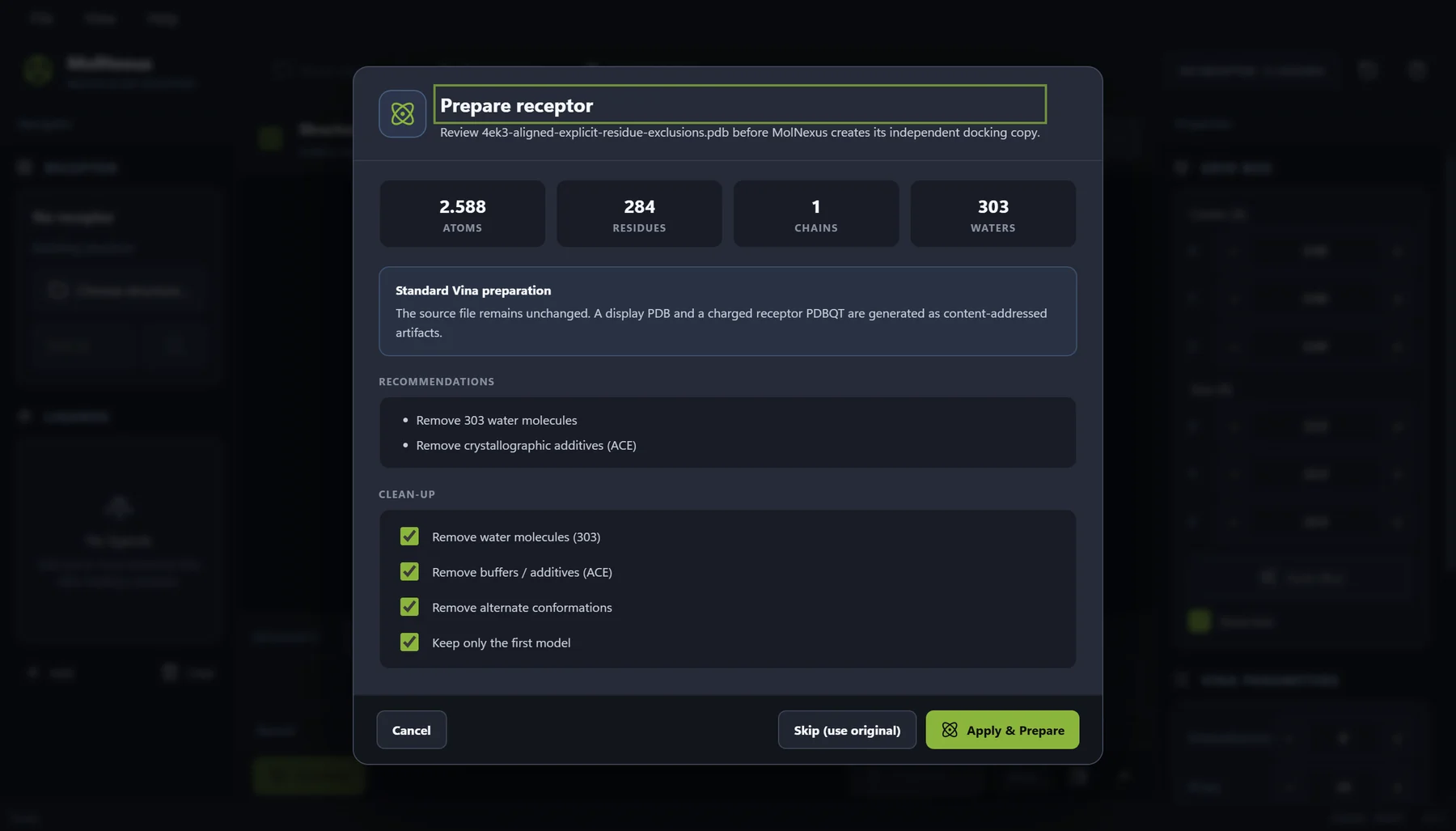
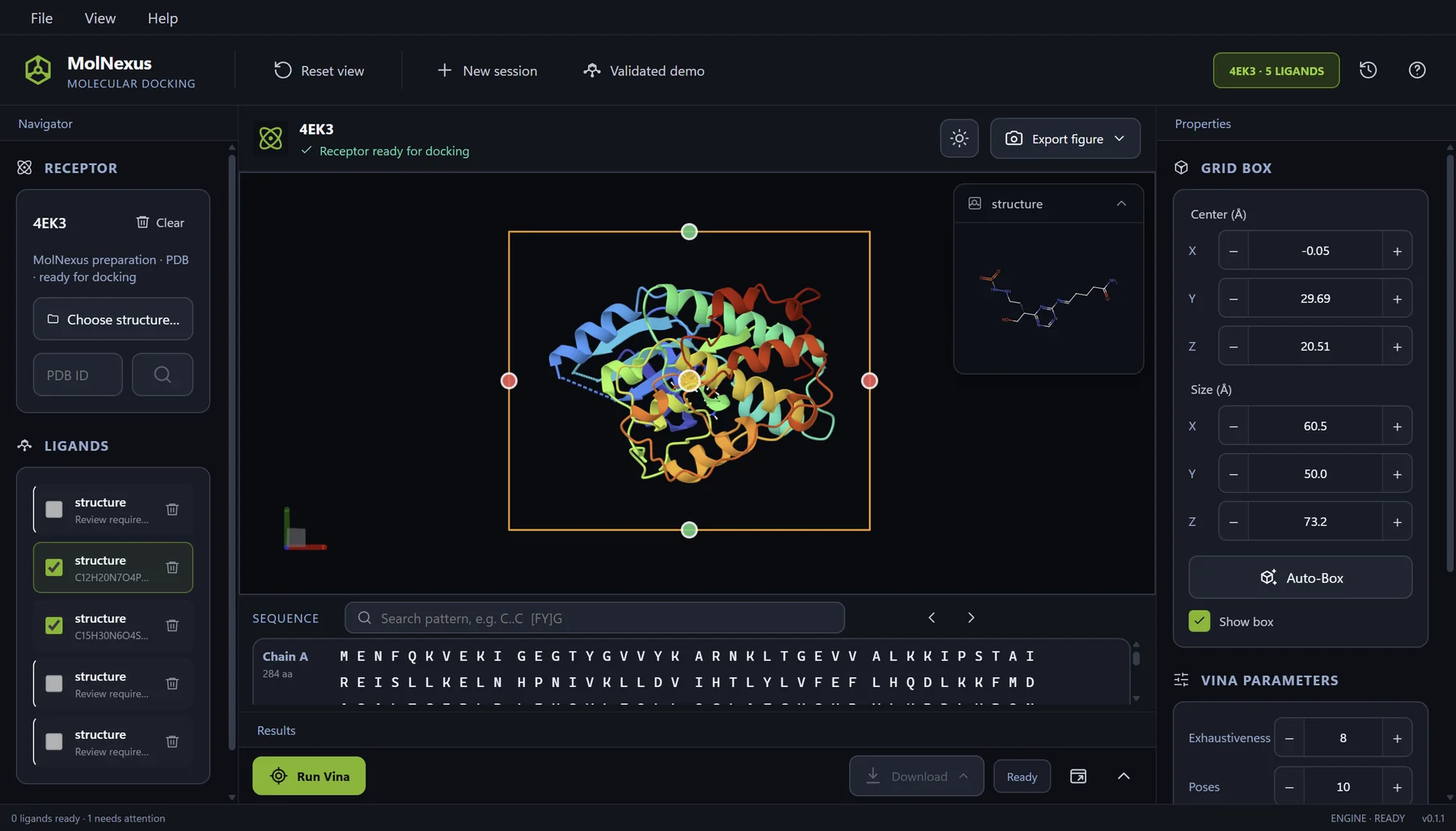
MolNexus 0.1.1 is a commercial Windows desktop workflow that exposes receptor review and ligand preparation before AutoDock Vina execution. The authentic captures below show the current Tauri interface, not a claim that the interface makes preparation scientifically correct. The researcher still owns the biological and chemical decisions.
The receptor example is the explicitly remediated 4EK3 input used for the documented CDK2 reproduction. Before clean-up, MolNexus reports 2,588 atoms, 284 protein residues, one chain, and 303 waters, then presents visible water and ACE choices. Across eight prespecified YuelDesign ligand files, two became Ready, three required Review, and three were rejected at import because no valid molecule records were available. No review decision was accepted automatically. These are workflow evidence from a working build, not a comparative benchmark.
Evaluate preparation software by the decisions it exposes
The same workflow in two buying contexts
| Buyer context | Evaluation question | Evidence to request |
|---|---|---|
| Individual professional | Will the workflow reduce repetitive setup while keeping the decisions visible enough for my own studies? | Supported inputs, authentic preparation views, version boundaries, export paths, and one-PC license terms. |
| Laboratory evaluator | Can researchers apply and review one preparation policy without hiding failures or source provenance? | Batch status, reproducibility records, local storage behavior, validation boundaries, and deployment limits. |
Frequently asked questions
Good preparation makes the docking question inspectable. It connects biological state, molecular chemistry, software parameterization, and retained provenance before search begins. Once those inputs are controlled, the next decision is where Vina is allowed to search and how much sampling that volume requires.
References
- Center for Computational Structural Biology. Basic docking AutoDock Vina documentation Official tutorial for receptor and ligand preparation, PDBQT generation, component removal decisions, and the SDF preference for small molecules.
- Center for Computational Structural Biology. Frequently Asked Questions AutoDock Vina documentation Official explanation of protonation, united-atom scoring, hydrogen interpretation, search behavior, and protocol limits.
- The Meeko authors. Basic ligand preparation Meeko documentation Official requirements and workflow for preparing ligand PDBQT files from chemistry-aware structures with explicit hydrogens and three-dimensional coordinates.
- The Meeko authors. Overview of receptor preparation Meeko documentation Official description of template-based receptor chemistry, structural issue detection, and receptor parameterization.
- Santos-Martins D, He Y, Eberhardt J, Sharma P, and colleagues. Meeko: Molecule Parametrization and Software Interoperability for Docking and Beyond Journal of Chemical Information and Modeling (2025) DOI: 10.1021/acs.jcim.5c02271 Original peer-reviewed paper on chemical perception, validation, and parameterization of ligands and macromolecular receptors.
- Eberhardt J, Santos-Martins D, Tillack AF, Forli S. AutoDock Vina 1.2.0: New Docking Methods, Expanded Force Field, and Python Bindings Journal of Chemical Information and Modeling (2021) DOI: 10.1021/acs.jcim.1c00203 Original peer-reviewed description of the current AutoDock Vina architecture and expanded docking methods.