How to Interpret AutoDock Vina Results: Affinity, RMSD, and Pose Selection
Learn what AutoDock Vina affinity, RMSD lower and upper bounds, and mode ranks actually mean—and use a documented c-Abl case to choose poses without relying on score alone.
AutoDock Vina can return a compact table that looks decisive:
one mode is first, its affinity is the most negative, and every
later mode has two RMSD values. The difficult part begins after the
calculation finishes. Which difference is meaningful? Are two
rows alternative conformations of the same pose family? Does
0.0 Å mean that mode 1 reproduces a crystal
structure?
This guide is for researchers interpreting their own protein–small-molecule docking results and for technical evaluators defining a review workflow for a laboratory. Whether an individual runs Vina directly or a laboratory evaluates software around it, the scientific task is the same: preserve the protocol, compare like with like, inspect the poses, and document why one result was retained.
What each AutoDock Vina result column answers
| Column | What it describes | What it does not establish |
|---|---|---|
| Mode | The rank assigned to a returned pose under the current run. | Experimental correctness or biological relevance. |
| Affinity (kcal/mol) | The score produced by the selected scoring function; more negative modes rank ahead within the controlled comparison. | A measured binding free energy, dissociation constant, or universal scale across protocols. |
| RMSD l.b. (Å) | A lower-bound heavy-atom distance from the best mode using nearest atoms of the same element [2,3]. | RMSD from a crystallographic ligand or a chemically constrained one-to-one atom mapping. |
| RMSD u.b. (Å) | A heavy-atom distance from the best mode using corresponding atom indices [2,3]. | Independent evidence that either pose is experimentally correct. |
Start with the right question: ranking or validation?
A Vina result table primarily answers a ranking question:
which poses did this search and scoring setup place first?
The official basic-docking tutorial prints affinity together with
“dist from best mode,” then labels those distances
rmsd l.b. and rmsd u.b. [1]. The Vina
1.2.7 source sets the first ranked pose as the best model and
computes the two distances for every returned mode against that
model [2].
Validation asks a different question: does the protocol recover a relevant reference or predict outcomes that matter for the intended study? Redocking RMSD, enrichment, known interaction recovery, experimental activity, and prospective testing are different forms of evidence. None appears automatically because a Vina row is ranked first.
1. Interpret affinity as a controlled ranking signal
Vina reports its affinity column in kcal/mol and sorts lower, more negative values first [1]. Within one receptor–ligand run, this makes affinity useful for prioritizing which modes to inspect first. Across a ligand library prepared and docked under one controlled protocol, it can also support a screening rank.
The number is still an output of an approximate scoring function. It is not an experimental measurement. Receptor state, ligand protonation and tautomer selection, search-box placement, exhaustiveness, seed, flexibility assumptions, scoring function, and other inputs can change the result. The official FAQ explicitly describes docking as approximate and identifies preparation, search, seed, receptor quality, and scoring limitations among the reasons a bound conformation may not be recovered [4].
When an affinity comparison is useful
| Comparison | How to interpret it |
|---|---|
| Modes of the same ligand in the same run | Use the score to set inspection order, then evaluate pose geometry and pose families. |
| Ligands in one controlled screen | Use the score as a prioritization feature while retaining preparation and protocol consistency. |
| Runs with different seeds or exhaustiveness | Compare whether the same pose family and similar score region recur; do not focus only on one lucky minimum. |
| Different scoring functions | Do not declare a winner from the raw numbers alone. Vina, AutoDock4, and Vinardo use different formulations and scales [1,5]. |
| Different receptors or unrelated targets | A raw score difference is not a universal cross-target measure of binding strength. |
2. Read RMSD l.b. and RMSD u.b. as bounds from mode 1
The practical difference between the two RMSD columns
| Property | RMSD l.b. | RMSD u.b. |
|---|---|---|
| Reference | Mode 1 in standard output. | Mode 1 in standard output. |
| Atoms | Movable heavy atoms. | Movable heavy atoms. |
| Correspondence | Nearest heavy atom of the same element; identity is relaxed. | Same indexed atom; identity is retained. |
| Useful signal | Whether a mode can be geometrically close when equivalent-element matching is allowed. | How far the fixed atom-to-atom representation moved. |
| Main caution | It is a bound, not a full chemically constrained symmetry mapping. | Equivalent or symmetric atoms can make the fixed correspondence look farther apart. |
Do not confuse Vina output RMSD with redocking RMSD
Redocking begins with a protein–ligand complex whose bound ligand pose is already known. After preparing and docking that ligand again, the generated pose can be aligned with the retained experimental reference and a separate RMSD can be calculated. That reference-ligand RMSD evaluates pose recovery for the declared case and mapping method.
The two Vina RMSD columns do not perform this validation in a normal result table. They organize the returned modes around mode 1. A report should therefore name a reference metric explicitly, for example “symmetry-aware heavy-atom RMSD to the crystallographic ligand,” and document the alignment and atom-mapping method.
Mode similarity and reference recovery are not interchangeable
| Metric | Reference object | Question answered |
|---|---|---|
| Vina RMSD l.b. / u.b. | Mode 1 in the standard output table. | How similar is this returned mode to the top-ranked mode? |
| Redocking RMSD | A separately retained experimental ligand pose. | How closely did the protocol recover this reference pose? |
| Cross-seed pose comparison | A pose family found in another controlled run. | Does the same solution recur when the stochastic search changes? |
A practical workflow for selecting a docking pose
Seven checks before retaining one mode
| Step | Question | Action |
|---|---|---|
| 1. Verify the run | Were receptor, ligand, protonation, box, scoring function, and parameters appropriate? | Resolve input or protocol problems before interpreting the ranking. |
| 2. Read the affinity spread | Is mode 1 clearly separated, or are several modes close in score? | Inspect every competitive mode rather than treating a small numerical gap as decisive. |
| 3. Identify pose families | Which modes are close to mode 1, and which represent a different orientation? | Use both RMSD bounds and direct three-dimensional inspection. |
| 4. Inspect pocket geometry | Are there severe clashes, implausible torsions, exposed groups, or missed cavity regions? | Reject geometrically implausible interpretations even when the score is attractive. |
| 5. Apply target knowledge | Does the pose satisfy relevant residues, motifs, cofactors, waters, or constraints supported by evidence? | State those criteria before choosing the pose to reduce confirmation bias. |
| 6. Test recurrence | Does the pose family recur with another seed or a justified increase in exhaustiveness? | Use controlled reruns when stochastic search uncertainty matters [4]. |
| 7. Retain the decision trail | Could another researcher reconstruct why this pose was selected? | Save inputs, versions, parameters, complete results, selected pose, alternatives, and rationale. |
Worked example: c-Abl and imatinib in PDB 1IEP
BioChemIntelli retained a reproducible redocking case using the c-Abl kinase domain and imatinib from PDB 1IEP. The RCSB record identifies the complex and reports an X-ray structure at 2.10 Å resolution [6]. The run used AutoDock Vina 1.2.7, the Vina scoring function, a 20 Å cubic box, exhaustiveness 32, nine requested modes, a 3 kcal/mol energy range, one CPU, and fixed seed 42. Five poses fell within the retained output range.
The example includes two different RMSD measurements: Vina's distances from mode 1 and a separately calculated symmetry-aware heavy-atom RMSD from each generated pose to the crystallographic ligand. Keeping both columns visible makes their different roles concrete.
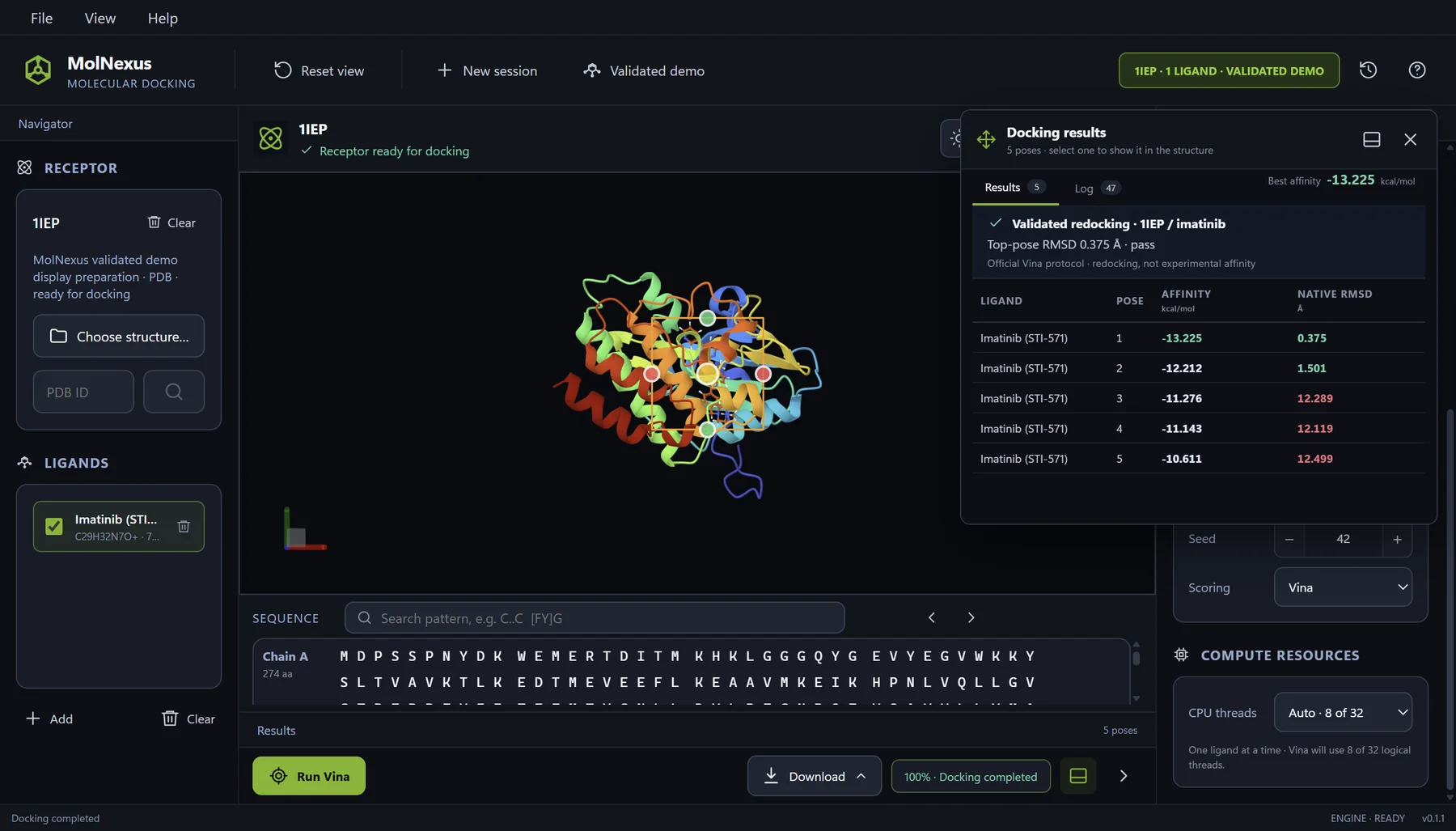
The five retained poses in the controlled 1IEP run
| Mode | Affinity (kcal/mol) | RMSD l.b. to mode 1 (Å) | RMSD u.b. to mode 1 (Å) | RMSD to crystal ligand (Å) |
|---|---|---|---|---|
| 1 | −13.225 | 0.000 | 0.000 | 0.375 |
| 2 | −12.212 | 1.090 | 1.564 | 1.501 |
| 3 | −11.276 | 3.022 | 12.416 | 12.289 |
| 4 | −11.143 | 3.821 | 12.272 | 12.119 |
| 5 | −10.611 | 2.552 | 12.621 | 12.499 |
What the 1IEP example does—and does not—show
| Supported by this retained case | Not established by this case |
|---|---|
| MolNexus executed AutoDock Vina 1.2.7 with the recorded protocol and fixed seed. | Universal docking accuracy across targets or ligand classes. |
| The interface displayed ranked affinities, RMSD bounds, the pose, and protocol settings together. | That a graphical interface improves the scientific accuracy of Vina. |
| The top-ranked pose was close to the retained crystallographic ligand under the documented RMSD method. | That the Vina affinity equals experimental binding free energy. |
| Mode-to-mode RMSD and reference-ligand RMSD answered different questions. | That one numerical cutoff is sufficient for every pose-selection decision. |
A compact reporting checklist
| Retain | Minimum useful detail |
|---|---|
| Inputs | Receptor and ligand identifiers, source files, preparation choices, protonation or tautomer assumptions, and file hashes when possible. |
| Software | Vina version, preparation tools, scoring function, visualization or analysis software, and operating environment. |
| Search space | Center, dimensions, units, and the structural rationale for the selected region. |
| Search parameters | Exhaustiveness, seed, requested modes, energy range, CPU setting, and flexible-residue choices when used. |
| Complete output | All retained modes, affinities, RMSD bounds, logs, failures, and exported coordinates—not only the selected row. |
| Selection rationale | Pose family, pocket geometry, target-specific constraints, alternative poses considered, and reasons for exclusion. |
| Validation metric | Reference object, alignment, atom mapping, threshold rationale, and result; label it separately from Vina's mode-to-mode RMSD. |
How MolNexus supports result review
MolNexus 0.1.1 is a Windows 10/11 desktop molecular docking application, available through BioChemIntelli, that integrates AutoDock Vina 1.2.7. Its current interface keeps the molecular pose, affinity, RMSD lower and upper bounds, search box, Vina parameters, and local job history within one workflow. Results and selected complexes can be exported for further analysis.
That visibility can reduce the operational friction of reviewing and revisiting a run. It does not decide that a pose is biologically correct, replace target-specific validation, or convert the Vina score into an experimental measurement. A free Windows trial limited to two ligand docking runs and the US$499 one-time perpetual license are available now.
The same review task in two buying contexts
| Context | Useful next question | Evidence to inspect |
|---|---|---|
| Individual researcher choosing a personal workflow | Will a local interface make repeated pose review and result recovery easier on the supported Windows PC? | Authentic captures, supported inputs, visible parameters, exports, license scope, and current availability. |
| Laboratory evaluator defining a shared method | Can the team preserve one review checklist and reconstruct why poses were selected? | Protocol records, complete result retention, documentation, deployment boundaries, and the current one-PC license model. |
If the scoring function itself is the decision, read Vina vs Vinardo: how to choose a scoring function. For a broader workflow evaluation, use the molecular docking software buyer guide. If result traceability is the bottleneck, continue with how to organize receptors, ligands, poses, and history.
Frequently asked questions
A strong AutoDock Vina interpretation does not end at the first row. It connects a controlled protocol, a ranked score, a mode-to-mode similarity pattern, direct pose inspection, relevant external evidence, and a retained rationale. When those pieces remain visible, affinity and RMSD become useful decision inputs instead of isolated numbers.
References
- Center for Computational Structural Biology. Basic docking AutoDock Vina documentation Official tutorial documenting the result table, affinity, distance-from-best-mode columns, 1IEP example, search space, exhaustiveness, and force-field comparison boundary.
- Center for Computational Structural Biology. AutoDock Vina 1.2.7 result-table implementation AutoDock Vina source code (2025) Official version-pinned source showing that the standard table sets the first pose as best_model and calculates both RMSD values against that reference.
- Center for Computational Structural Biology. AutoDock Vina 1.2.7 RMSD bound implementation AutoDock Vina source code (2025) Official version-pinned source defining the lower-bound same-element nearest-neighbor calculation and upper-bound indexed heavy-atom calculation.
- Center for Computational Structural Biology. Frequently Asked Questions AutoDock Vina documentation Official documentation on search-space size, protonation, exhaustiveness, seeds, stochastic reproducibility, and the approximate nature of docking.
- Quiroga R, Villarreal MA. Vinardo: A Scoring Function Based on AutoDock Vina Improves Scoring, Docking, and Virtual Screening PLOS ONE (2016) DOI: 10.1371/journal.pone.0155183 Original peer-reviewed paper defining Vinardo as a modified scoring function with changed terms, radii, parameters, and weights.
- RCSB Protein Data Bank. 1IEP: Crystal structure of the c-Abl kinase domain in complex with STI-571 RCSB PDB (2001) Authoritative structure record for the c-Abl–imatinib complex, experimental method, and 2.10 Å resolution.
- Center for Computational Structural Biology. AutoDock Vina 1.2.7 release GitHub Releases (2025) Official release record for the engine version used in the retained MolNexus 1IEP case.