How to Set an AutoDock Vina Grid Box: Center, Size, and Exhaustiveness
Set an AutoDock Vina search space with defensible center and size coordinates, then pair box volume with exhaustiveness, seeds, visualization, and a reproducible validation record.
The search space is one of the most consequential AutoDock Vina settings because it defines where the movable ligand is allowed to explore. A box that misses part of the binding site excludes that region before scoring begins. A box that covers the entire protein for a focused docking question makes the search harder and can spend sampling effort on irrelevant surface regions.
This guide explains center, size, volume, exhaustiveness, and seed as one protocol. It also separates focused docking from blind exploration and shows how to evaluate software that helps position the box without pretending to choose the biology for you.
What each Vina search parameter controls
| Parameter | What it controls | What it does not establish |
|---|---|---|
| Center x, y, z | The Cartesian midpoint of the allowed search space. | That the selected location is the biologically relevant pocket. |
| Size x, y, z | The full box length along each axis, in angstroms for Vina. | That every included region will be sampled equally well. |
| Exhaustiveness | The number of independent search runs in the current implementation [1]. | Guaranteed convergence or experimental correctness. |
| Seed | The reproducible starting state for Vina's stochastic search. | Robustness across independent searches. |
| Pose count and energy range | How many sufficiently ranked output modes can be retained within the configured range. | How much of the search space was explored. |
The box is a spatial hypothesis, not a neutral default
A focused box states, in coordinates, where binding is expected to occur. A blind-docking box states that the site is uncertain and a broader region must be explored. Those are different scientific questions and should not be reported as interchangeable settings.
The original AutoDock Vina method combines stochastic global optimization with local optimization [4]. The current FAQ describes multiple independent runs and explains that larger search spaces make the search problem harder [1]. Box design and sampling effort therefore belong in the same protocol.
1. Decide whether the task is focused or exploratory
Choose the search question before choosing coordinates
| Situation | Reasonable starting strategy | Main risk |
|---|---|---|
| Co-crystallized ligand defines the site | Center on the reference ligand or pocket and add justified margin. | Overfitting the box to one ligand shape. |
| Known active-site residues, no bound ligand | Center on the residue-defined pocket and inspect the full cavity in 3D. | Using a residue centroid that does not match the usable cavity. |
| Predicted pocket | Treat the prediction and box as one uncertain hypothesis; compare alternatives when warranted. | Converting pocket-prediction uncertainty into false docking confidence. |
| Unknown site or blind exploration | Use a deliberately exploratory protocol, potentially staged across regions. | Assuming one very large box is equivalent to a validated focused search. |
2. Place the center on the intended binding region
For a known site, common anchors include the geometric center of
a co-crystallized ligand, the center of a set of site residues, or
the center of a cavity identified by structural evidence. The
official basic-docking example uses the 1IEP ligand location and
specifies the center as 15.190, 53.903, and 16.917 angstrom [2].
The Python tutorial passes the same values to
compute_vina_maps [3].
A calculated centroid is only a starting coordinate. View it against the receptor and confirm that it sits inside the intended cavity rather than inside a protein surface, between domains, or on the wrong chain.
3. Make each dimension large enough, but no larger
Choose size independently along x, y, and z. The box should contain the complete ligand, the intended cavity, reasonable translational and orientational movement, and any selected flexible side-chain region. It does not need to be cubic when the pocket is elongated.
The official guidance is memorable: make the search space as small as possible, but not smaller [1]. This is not an invitation to crop tightly around one known pose. It is a reminder that every additional angstrom expands the search problem and should have a reason.
Signs that a box is too small or too large
| Observation | Likely issue | Next check |
|---|---|---|
| Part of the reference ligand crosses an edge | The box is too small or miscentered. | Recalculate bounds and inspect every axis. |
| A plausible orientation would require leaving the box | Margin is too tight for the ligand or site geometry. | Expand only the limiting dimension and retest. |
| The box contains large solvent-exposed surfaces unrelated to the pocket | The focused search is broader than its hypothesis. | Reduce or stage the search unless exploration is intentional. |
| Independent runs return unrelated regions without stable pose families | The space may be too broad for the sampling effort, or the site hypothesis is weak. | Review site definition, dimensions, exhaustiveness, and seeds together. |
4. Pair search-space volume with exhaustiveness
Do not change center, size, exhaustiveness, seed, ligand state, and receptor preparation at the same time when diagnosing unstable docking. Hold the scientific inputs fixed and vary one search control deliberately. Compare pose families and site occupancy, not only the most negative affinity.
The expanded Vina 1.2 architecture retains stochastic global search and local refinement while adding scoring and protocol options [5]. That flexibility makes a versioned configuration even more important.
5. Use seeds to test recurrence, not to hunt for one score
A fixed seed makes one stochastic run reproducible. Multiple controlled seeds test whether a pose family recurs under the same receptor, ligand, box, scoring function, and exhaustiveness. If only one seed produces the preferred pose, report that instability rather than selecting the run silently.
Keep a per-run record containing center, dimensions, exhaustiveness, seed, scoring function, requested modes, energy range, receptor file, ligand file, engine version, and output. This is also why software selection should be evaluated around the workflow, as explained in the molecular docking software buyer guide.
6. Visualize the box before running Vina
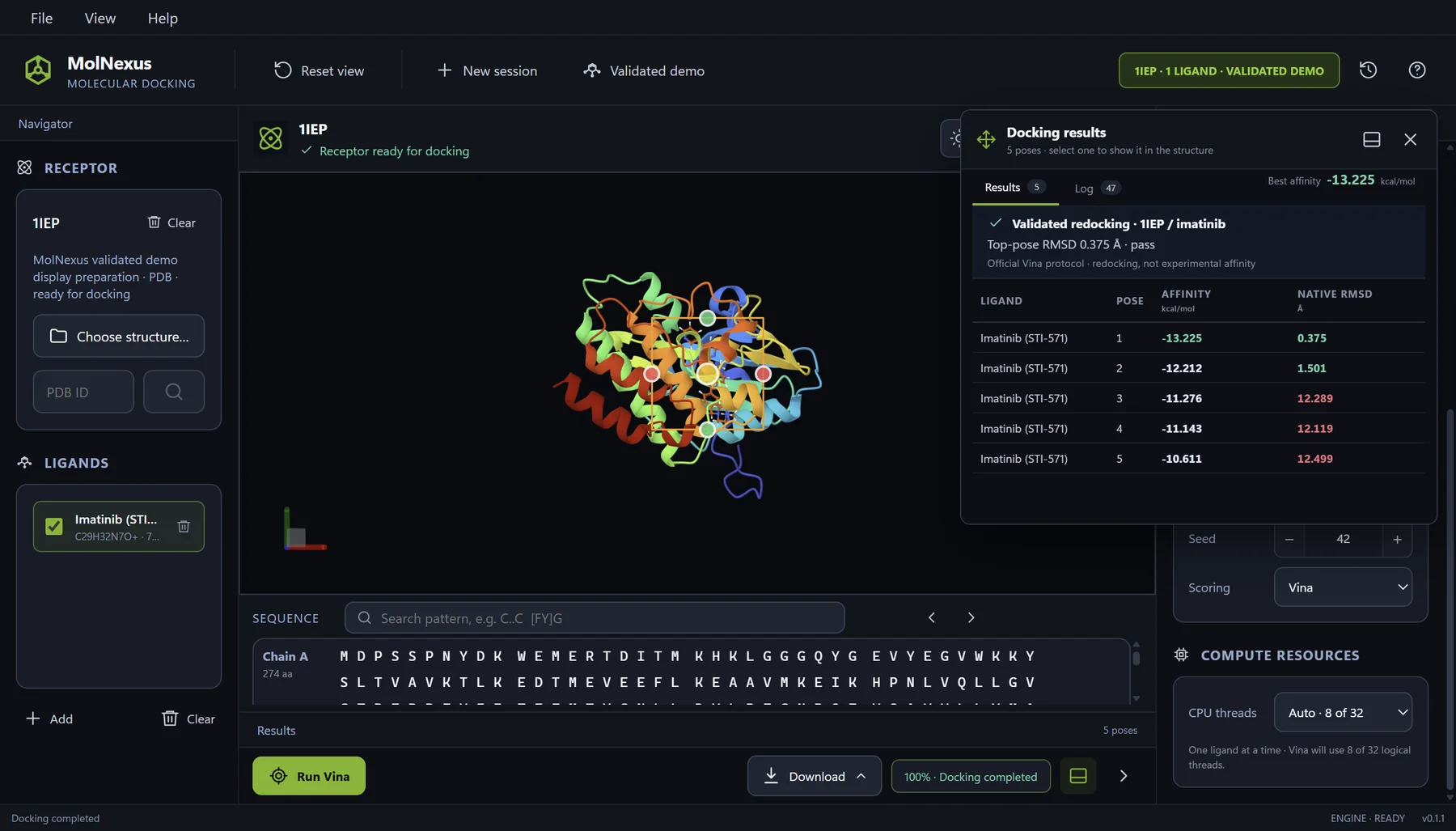
The retained case uses the c-Abl-imatinib structure 1IEP [8] and AutoDock Vina 1.2.7 [7]. Its purpose here is operational: the box and run controls can be inspected in the same view as the receptor and ligand. A researcher can see whether the ligand is inside the volume before execution and retain the exact settings with the result.
The scientific decision remains target-specific. An interface can make a box visible and editable; it cannot determine that the chosen pocket is biologically correct.
A reproducible way to derive a box from a reference ligand
Coordinate calculation
| Quantity | Calculation for each axis |
|---|---|
| Padded minimum | minimum ligand coordinate minus chosen padding |
| Padded maximum | maximum ligand coordinate plus chosen padding |
| Center | (padded minimum + padded maximum) / 2 |
| Size | padded maximum - padded minimum |
This bounding-box calculation creates a transparent starting point. Meeko examples also support enveloping a reference ligand with an explicit padding value [6]. Always inspect the result and adapt it to the intended ligand series and pocket geometry.
A box-validation protocol before production docking
Seven checks before accepting the search space
| Check | Question |
|---|---|
| Site provenance | What experimental, structural, or predictive evidence defines this region? |
| Coordinate units | Are Vina dimensions entered in angstroms rather than copied as AutoDock4 grid points? |
| Visual containment | Are the full reference ligand and intended cavity inside every edge? |
| Ligand-series fit | Can representative larger or differently shaped ligands explore the site? |
| Irrelevant volume | Does the box include broad regions unrelated to the stated hypothesis? |
| Sampling stability | Do pose families recur across controlled seeds or increased exhaustiveness? |
| Record completeness | Are center, size, version, inputs, seed, exhaustiveness, and outputs retained together? |
Evaluate grid-box software by visibility and recoverability
The same decision in two buying contexts
| Buyer context | Evaluation question | Evidence to inspect |
|---|---|---|
| Individual professional | Can I position and verify the box quickly without losing the exact coordinates and Vina settings? | Authentic 3D box controls, saved configurations, exports, and one-PC license boundary. |
| Laboratory evaluator | Can a shared method make site definition, box dimensions, sampling, and reruns reviewable? | Parameter visibility, local history, version tracking, validation limits, and deployment scope. |
Frequently asked questions
A defensible AutoDock Vina search space connects site evidence, coordinates, ligand dimensions, visualization, sampling effort, seeds, and retained records. When those elements remain visible, the box becomes a reproducible part of the method instead of an unexplained rectangle around a favorable result.
After docking, use the separate guide to interpret affinity, RMSD bounds, and pose families without turning the top row into automatic validation.
References
- Center for Computational Structural Biology. Frequently Asked Questions AutoDock Vina documentation Official guidance on search-space size, angstrom units, the 27,000 cubic angstrom warning, exhaustiveness, seeds, and stochastic search behavior.
- Center for Computational Structural Biology. Basic docking AutoDock Vina documentation Official 1IEP tutorial with box center, 20 angstrom dimensions, configuration file, and Vina execution workflow.
- Center for Computational Structural Biology. Python scripting AutoDock Vina documentation Official Python example defining Vina maps with explicit center and box-size values.
- Trott O, Olson AJ. AutoDock Vina: Improving the Speed and Accuracy of Docking with a New Scoring Function, Efficient Optimization, and Multithreading Journal of Computational Chemistry (2010) DOI: 10.1002/jcc.21334 Original peer-reviewed description of the Vina scoring and stochastic global-plus-local optimization method.
- Eberhardt J, Santos-Martins D, Tillack AF, Forli S. AutoDock Vina 1.2.0: New Docking Methods, Expanded Force Field, and Python Bindings Journal of Chemical Information and Modeling (2021) DOI: 10.1021/acs.jcim.1c00203 Original peer-reviewed description of the expanded AutoDock Vina architecture, scoring options, and Python interface.
- The Meeko authors. Tethered Docking Meeko documentation Official example of deriving a box by enveloping a reference ligand with an explicit padding value.
- Center for Computational Structural Biology. AutoDock Vina 1.2.7 release GitHub Releases (2025) Official release record for the AutoDock Vina engine version used in the retained MolNexus case.
- RCSB Protein Data Bank. 1IEP: Crystal structure of the c-Abl kinase domain in complex with STI-571 RCSB PDB (2001) Authoritative structure record for the c-Abl-imatinib complex used in the retained box-visualization case.