Vina vs Vinardo: How to Choose a Scoring Function for Reproducible Molecular Docking
Compare Vina and Vinardo without mistaking a more negative score for better docking. Use a controlled protocol, target-relevant validation, and a real c-Abl case.
This guide is for computational chemists, molecular modelers, and research teams deciding whether a small-molecule docking workflow should use Vina, Vinardo, or a target-specific comparison of both. The practical question is not “Which scoring function wins everywhere?” It is “Which function is sufficiently reliable for the decision this project needs to make?”
That distinction matters because docking can be asked to recover a plausible pose, rank ligands for one target, enrich known actives in a screen, or approximate measured affinity. Those are related tasks, but they are not interchangeable. A scoring function can perform differently across them [1].
What are Vina and Vinardo?
Vina is the default empirical scoring function associated with
AutoDock Vina. Vinardo—short for Vina RaDii
Optimized—was developed from the Vina framework and originally
evaluated in scoring, docking, ranking, and virtual-screening tests by
Quiroga and Villarreal [1]. Current AutoDock Vina exposes
vina and vinardo as selectable scoring-function
names in its official API [2].
Vinardo retains the broad families of steric, hydrophobic, and nondirectional hydrogen-bond interactions used by Vina, but it is not merely a renamed preset. Its published formulation removes Vina's second attractive Gaussian term and changes atomic radii, parameters, and term weights [1]. Those changes alter the landscape used to evaluate and search protein–ligand poses.
Vina vs Vinardo at a glance
| Question | Vina | Vinardo |
|---|---|---|
| Relationship | Default AutoDock Vina scoring function. | Alternative function derived from the Vina framework. |
| Interaction families | Steric, hydrophobic, and nondirectional hydrogen-bond terms. | Uses the same broad families with a simplified published formulation. |
| Important formulation differences | Includes two attractive Gaussian terms in the published comparison. | Removes the second Gaussian and changes radii, parameters, and weights [1]. |
| Current AutoDock Vina selection | --scoring vina |
--scoring vinardo [2,3] |
| Best default? | Neither label replaces target-relevant validation. | |
Ask which kind of performance you need
The original Vinardo study separates four capabilities that are often compressed into the word “accuracy” [1]. Keeping them separate makes a software and protocol decision much easier to defend.
Four different validation questions
| Capability | Question | Useful evidence |
|---|---|---|
| Docking power | Can the function rank a near-native pose above alternative generated poses? | Controlled redocking against crystallographic complexes, with a declared RMSD method and threshold. |
| Scoring power | Do predicted scores correlate with measured affinities across suitable complexes? | A curated set with experimental affinity data and an explicit correlation analysis. |
| Ranking power | Can it order ligands for the same target in a useful way? | Known congeneric or target-specific ligands with reliable measurements. |
| Screening power | Can it prioritize true actives from a candidate pool? | Known actives, appropriate decoys or inactives, and enrichment or ranking metrics. |
How to compare Vina and Vinardo reproducibly
A fair comparison changes one variable: the scoring function. If protonation, receptor coordinates, ligand geometry, search space, or random seed also changes, the result can no longer be attributed to Vina versus Vinardo alone. AutoDock Vina's official API exposes the scoring function and seed as explicit inputs, making both part of the recorded protocol [2].
Preparation deserves particular attention. Use the same prepared receptor and ligand files—not merely files with the same names. Retain checksums when possible. Then preserve the complete commands, software version, pose files, logs, and analysis method alongside the result.
Controlled-comparison checklist
| Keep fixed | Record explicitly |
|---|---|
| Receptor coordinates and preparation | Source structure, selected chains, retained cofactors or waters, protonation assumptions, prepared-file checksum. |
| Ligand identity and preparation | Stereochemistry, protonation or tautomer policy, charges, rotatable bonds, prepared-file checksum. |
| Search space | Center and dimensions in ångströms, plus the method used to define the box. |
| Search settings | Exhaustiveness, number of modes, energy range, CPU setting, and positive random seed. |
| Evaluation | RMSD implementation and threshold, ranking or enrichment metric, exclusions, and failed runs. |
| Software | Engine version, interface version, scoring function, command, and output files. |
Use target-relevant validation, not a universal leaderboard
The 2016 Vinardo paper reported better results than Vina across the datasets and tests used in that study [1]. That is meaningful published evidence for considering Vinardo. It is not proof that Vinardo must win for every protein family, receptor state, ligand series, preparation protocol, or screening objective.
For pose prediction, begin with multiple crystallographic complexes relevant to the target or close analogs—not one convenient success. Predefine the near-native criterion, commonly an RMSD threshold for the redocked ligand, and report both successes and failures. For screening, use target-specific actives and well-designed decoys or inactives, then compare the metric that matches the project: early enrichment, ranking, recall at a budget, or another prespecified endpoint.
Real controlled case: c-Abl and imatinib
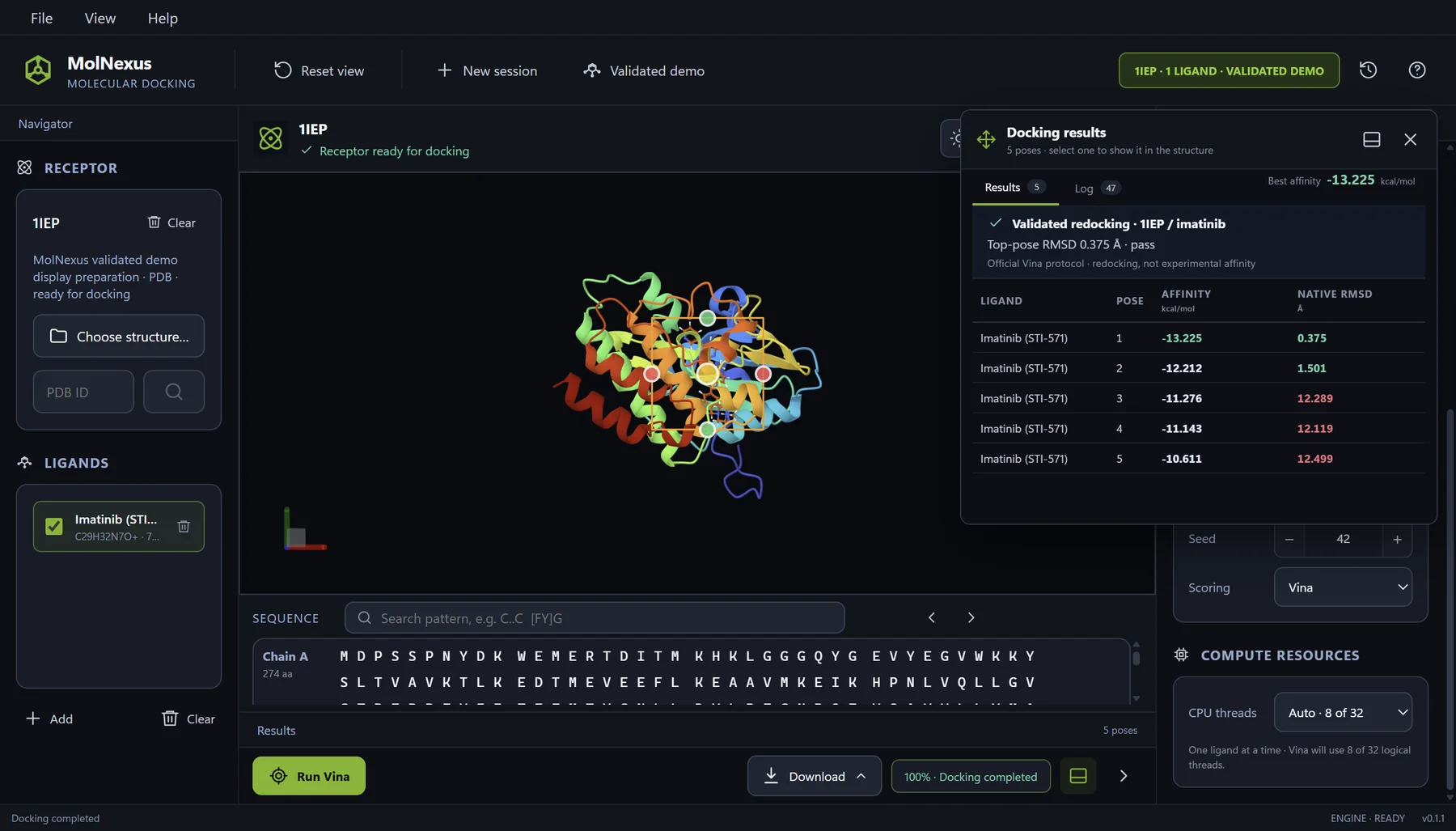
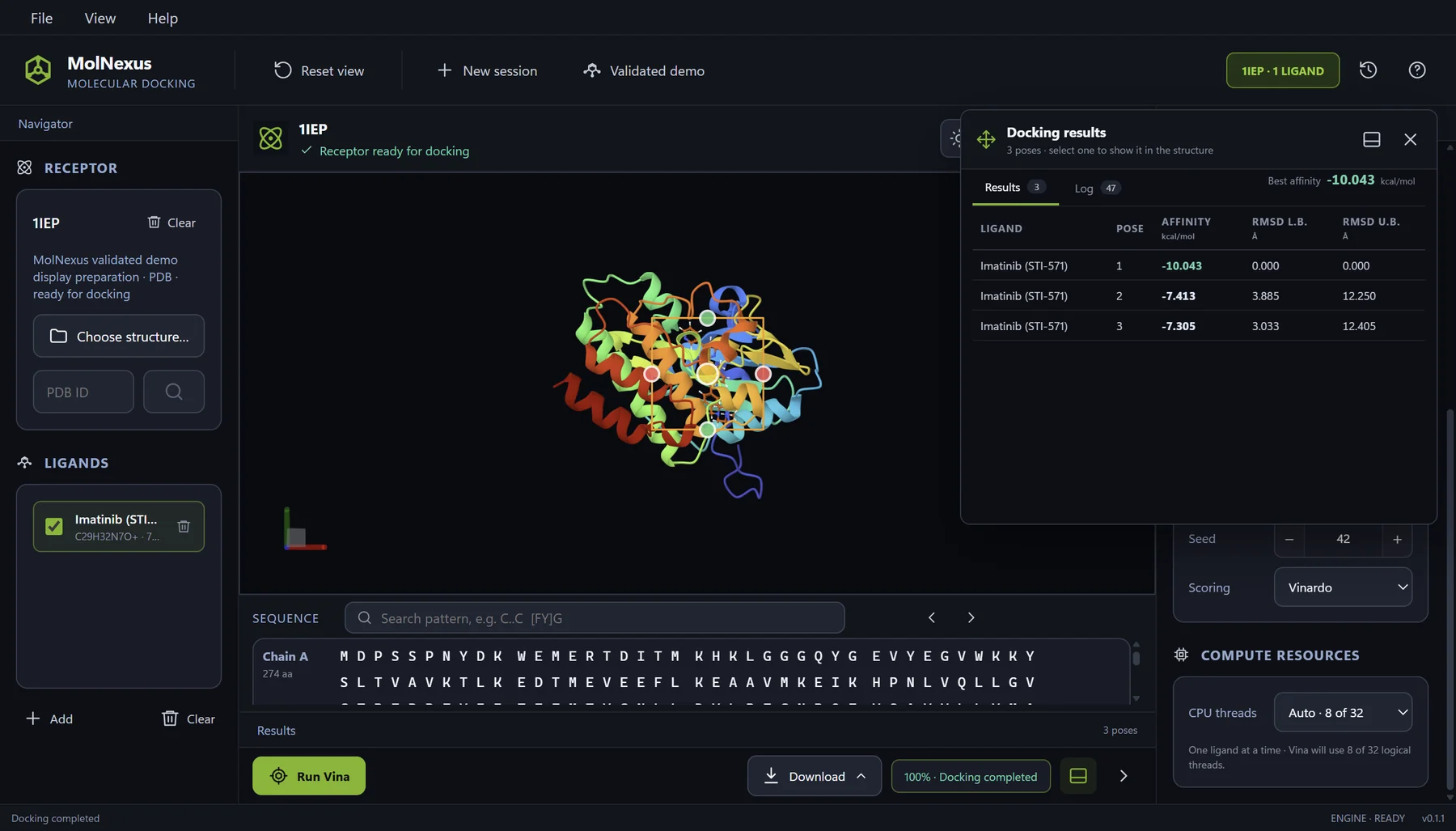
To demonstrate the comparison operationally, we redocked imatinib (STI-571) into the c-Abl kinase structure PDB 1IEP. RCSB PDB identifies 1IEP as an X-ray structure of the c-Abl kinase domain in complex with STI-571 at 2.10 Å resolution [4]. The official AutoDock Vina basic docking tutorial also uses this complex and explicitly documents how to switch the same example to Vinardo [3].
We ran both functions through MolNexus 0.1.1 and its bundled AutoDock
Vina 1.2.7 engine. The prepared receptor, prepared ligand, reference
ligand, search box, exhaustiveness, requested modes, energy range, seed,
and CPU setting were identical. Only
--scoring vina versus
--scoring vinardo changed.
Protocol retained for both runs
| Parameter | Value |
|---|---|
| Complex | PDB 1IEP · c-Abl kinase · imatinib (STI-571) |
| Box center (Å) | 15.190, 53.903, 16.917 |
| Box size (Å) | 20 × 20 × 20 |
| Exhaustiveness | 32 |
| Requested modes · energy range | 9 · 3.0 kcal/mol |
| Seed · CPU | 42 · 1 |
| Changed variable | Scoring function only |
What happened in this single case
| Scoring function | Top score (kcal/mol) | Current crystallographic RMSD report | Retained poses |
|---|---|---|---|
| Vina | −13.225 | 0.375 Å; validated-demo pass | 5 |
| Vinardo | −10.043 | Not reported after the scoring customization | 3 |
Changing the scoring function intentionally removes MolNexus's validated-demo label. The current Vinardo run therefore supports a controlled score and pose-count comparison, but this article does not assign it a new crystallographic RMSD value.
The current Vina run reproduced the crystallographic ligand at 0.375 Å and passed the prespecified 2 Å threshold. The current Vinardo run produced a top score of −10.043 kcal/mol and retained three poses, but changing the scoring function deliberately removed MolNexus's validated-demo label; no new crystallographic RMSD was reported for that customized run. The evidence therefore does not support saying that both runs recovered the native pose.
The useful conclusion is narrower and stronger: changing only the scoring function changed the displayed score and retained-pose outcome. Vina and Vinardo scores should not be compared as though they shared one absolute scale, and this single case does not establish universal superiority. The commands, reports, output poses, checksums, and source captures are retained with this article's evidence record.
When should you use Vina, Vinardo, or both?
A practical selection matrix
| Situation | Reasonable next step |
|---|---|
| You have a validated Vina protocol for this target and ligand class. | Keep Vina as the baseline. Change only when target-relevant evidence justifies the transition. |
| You are establishing a new docking protocol and have several suitable crystal complexes. | Redock the same curated set with both functions, then compare prespecified pose-recovery metrics. |
| You are planning virtual screening and have known actives plus appropriate decoys or inactives. | Compare target-specific ranking and early-enrichment performance; do not select from redocking alone. |
| You have no target-relevant validation set. | Use a documented baseline cautiously and state that the function has not been validated for this target. |
| The two functions prioritize meaningfully different compounds. | Inspect poses and chemistry, then consider a prespecified consensus or diversity strategy instead of silently merging scores. |
Running both functions can be useful, but “two scores are better than one” is not a validation method. Decide in advance how disagreement will be handled. Will one function be selected from a validation set? Will each generate an independent shortlist? Will a compound advance only when its pose is chemically plausible under both? The rule should exist before the results are visible.
For large libraries, test the protocol on a representative validation subset before committing the entire compute budget. This is also where workflow friction becomes visible: repeated preparation, untracked parameter changes, ambiguous filenames, or results separated from their poses can cost more than the additional docking run.
How MolNexus makes the comparison operational
MolNexus exposes Vina and Vinardo within the same local desktop workflow. The scoring selector sits beside exhaustiveness, requested poses, energy range, and seed, while the receptor, ligand list, search box, three-dimensional pose, and ranked results remain in context. That does not validate a scoring function automatically; it reduces the operational distance between a fair comparison and its evidence.
Completed work can be retained in local SQLite history and reopened with its context. Results can be exported to PDF and Excel, and selected complexes can be exported for downstream inspection. If your larger problem is organizing receptors, ligands, runs, and poses, see the guide to keeping molecular docking runs organized. For broader purchasing criteria, use the molecular docking software selection guide.
Current MolNexus product profile
| Workflow | Receptor and ligand preparation, interaction-box definition, local docking, Mol* pose review, history, and export. |
|---|---|
| Docking engine | AutoDock Vina 1.2.7 with Vina and Vinardo scoring selections. |
| Environment | Windows 10/11, 64-bit; local desktop application. |
| Commercial model | US$499 one-time purchase; one Windows PC at a time; perpetual use of the purchased version; 12 months of updates. |
| Availability | Available now: free two-docking trial and US$499 one-time perpetual license. |
Frequently asked questions
A compact decision checklist
| Before choosing | Done? |
|---|---|
| Define whether the project needs pose recovery, ranking, screening enrichment, or another endpoint. | □ |
| Prepare one target-relevant validation set and document inclusion criteria. | □ |
| Keep prepared inputs, box, search settings, seed, and evaluation method fixed. | □ |
| Change only the scoring function and retain all commands, outputs, versions, and failures. | □ |
| Compare both functions against the external endpoint, not against each other's raw score. | □ |
| Predefine what happens when the functions disagree. | □ |
A scoring-function choice becomes defensible when another researcher can reconstruct why it was made. Start with the endpoint, control the protocol, retain the evidence, and let target-relevant performance—not familiarity or the most negative number—decide.
If predicted structures are part of the upstream workflow, the guide to AlphaFold structures and molecular docking explains where receptor confidence enters the decision before either scoring function is run.
References
- Quiroga R, Villarreal MA. Vinardo: A Scoring Function Based on AutoDock Vina Improves Scoring, Docking, and Virtual Screening PLOS ONE 11(5):e0155183 (2016) DOI: 10.1371/journal.pone.0155183 Original peer-reviewed Vinardo paper describing the formulation, training, and tested scoring, ranking, docking, and screening results.
- Center for Computational Structural Biology. AutoDock Vina Python API reference AutoDock Vina documentation Official API reference documenting vina, vinardo, and ad4 scoring names and the random-seed input.
- Center for Computational Structural Biology. Basic docking AutoDock Vina documentation Official 1IEP c-Abl–imatinib tutorial and Vinardo scoring example.
- Nagar B, Bornmann WG, Pellicena P, et al. Crystal structure of the c-Abl kinase domain in complex with STI-571 RCSB Protein Data Bank, PDB 1IEP (2002) Original RCSB structure record; X-ray diffraction at 2.10 Å.
- Center for Computational Structural Biology. AutoDock Vina source repository GitHub Official AutoDock Vina source-code repository.