Why Some Ligands Fail Before AutoDock Vina: A Practical SDF Preflight Checklist
An SDF file can load and still be unfit for docking. Diagnose valence, aromaticity, fragments, stereochemistry, hydrogens, 3D geometry, minimization, and PDBQT failures before AutoDock Vina.
An .sdf filename is a container and format
declaration, not proof that a molecule is ready for docking.
Meeko's current ligand-preparation documentation expects an RDKit
molecule with explicit hydrogen atoms and 3D coordinates; Meeko
then assigns docking parameters and produces the PDBQT consumed by
AutoDock Vina [1,2]. It does not silently invent the missing
hydrogens or coordinates [2].
That boundary explains a frustrating class of failures: a structure can look acceptable in a viewer, yet stop before Vina ever starts. The practical question is therefore not merely Can this file be converted? It is Can every chemical decision between the source record and the docking input be inspected and defended?
The failure often occurs before Vina starts
The path from SDF to a Vina result contains several separate transformations:
source SDF record → parsed molecule → sanitized chemical graph → selected docking state → usable 3D geometry → parameterized PDBQT → AutoDock Vina search.
Only the final step is docking. If a workflow collapses all earlier failures into a generic "conversion error," the researcher cannot tell whether the problem is a malformed record, an impossible valence, an unresolved salt, an unspecified stereocenter, a geometry problem, or a prepared-file mismatch.
A four-gate SDF preflight
| Gate | Question | Evidence to retain |
|---|---|---|
| 1. Record integrity | Can one stable molecular record be parsed from the source? | Source name, record index, identifier, file hash, and parser result. |
| 2. Chemical graph | Are bond orders, formal charges, valence, aromaticity, and fragments chemically interpretable? | Sanitization status, atom-level diagnostics, fragment inventory, and any documented correction. |
| 3. Docking state | Are stereochemistry, protonation, hydrogens, and 3D geometry suitable for the intended protocol? | State-selection policy, unresolved warnings, coordinate provenance, and minimization outcome. |
| 4. Prepared artifact | Did parameterization produce a PDBQT that remains consistent with the intended ligand? | Tool versions, settings, atom and charge checks, artifact hash, and terminal status. |
1. Parse one stable molecular record
An SDF can contain one molecule or many [1]. Before chemistry is evaluated, confirm that the intended record can be read and assigned a stable identity. Truncated blocks, inconsistent atom or bond counts, broken delimiters, and empty records belong to this gate. They should not be disguised as chemistry failures.
For a batch, preserve the source filename, record position, molecular title or external identifier, and a checksum. If a parser returns no molecule, record that terminal state explicitly. Silent omission changes the denominator: a report of 94 completed ligands means something different if six other submitted records disappeared without explanation.
2. Sanitize the chemical graph before repairing it
RDKit sanitization generates chemical properties such as ring
membership and hybridization while checking whether a molecule
can be represented by a reasonable Lewis structure [3]. Its
default valence checks reject atoms whose specified bond orders
and hydrogen count exceed the allowed valence [3]. RDKit can also
report specific problems such as an
AtomValenceException or
KekulizeException [4].
Those messages are diagnostic, not instructions to delete a bond or neutralize an atom until the error disappears. First compare the record with the authoritative source. A wrong formal charge, bond order, aromatic flag, or hydrogen placement may be a transcription problem. Unusual but intentional chemistry may instead require a documented specialist workflow.
3. Resolve the docking state instead of guessing it
A chemically parseable record can still leave decisions that matter to docking. A salt or solvent fragment must not be removed merely because it is smaller. An undefined stereocenter must not become an arbitrary isomer. A protonation or tautomer state must match a stated policy and intended environment.
Hydrogen handling is particularly easy to underestimate. Vina uses a united-atom scoring function, but its documentation states that input hydrogens determine hydrogen-bond donor and acceptor assignments [6]. The basic Vina tutorial also advises checking protonation and warns against using PDB as the source format for small-molecule preparation because it does not carry bond connectivity [5].
Finally, Meeko expects explicit hydrogens and 3D positions [1,2]. If coordinates are absent, flat, or implausible, generate and inspect a conformer under a declared method. If minimization reaches a limit or the chemistry is unsupported by the chosen force field, preserve the warning rather than promoting the ligand silently.
Questions that require an explicit preparation policy
| Decision | What to establish | What not to do silently |
|---|---|---|
| Fragments | Identify the parent component, salt, solvent, or intended multicomponent system from provenance. | Keep the largest fragment merely because it has the most heavy atoms. |
| Stereochemistry | Confirm the intended isomer, enumerate under a declared rule, or retain an unresolved review state. | Invent one stereoisomer and present it as the source molecule. |
| Protonation and tautomers | Record the method, relevant pH assumptions, and whether multiple states are evaluated. | Equate one automatically generated state with chemical truth. |
| Hydrogens | Add explicit hydrogens after the chemical state is selected and verify donor/acceptor assignments. | Add hydrogens before resolving charge and protonation ambiguity. |
| 3D geometry | Record whether coordinates were supplied, generated, or minimized and with which method. | Treat a flat depiction or nonconverged geometry as an ordinary docking conformer. |
4. Verify the PDBQT instead of trusting file creation
Meeko uses the sanitized RDKit molecule to assign AutoDock atom types, partial charges, and rotatable bonds before writing PDBQT [2]. A successful write is necessary, but it is not the final integrity check. Connect the prepared artifact to the exact source record and preparation report, then verify basic invariants such as identity, expected heavy atoms, formal-charge consistency, finite coordinates, and a nonempty rotatable-bond model.
If that comparison fails, exclude the artifact from the current run and preserve the reason. Regenerating files until one happens to pass removes the evidence needed to understand which chemical assumption changed.
Common SDF-to-PDBQT symptoms and the correct next action
| Observed symptom | Likely gate | Next action | Dangerous shortcut |
|---|---|---|---|
| No molecule returned from one SDF record | Record integrity | Inspect that exact record, delimiters, counts, and source provenance. | Drop it from the batch without recording the failure. |
| Explicit valence is greater than permitted | Chemical graph | Check formal charge, bond order, and hydrogen placement against the authoritative structure. | Disable the check and assume the molecule is repaired. |
| Cannot kekulize molecule | Chemical graph | Inspect aromatic flags, ring bonds, charges, and heteroatom hydrogen state. | Rewrite aromatic bonds without documenting the interpretation. |
| Multiple disconnected fragments | Docking state | Identify the intended component from provenance or hold for review. | Automatically keep the largest fragment in every case. |
| Undefined stereochemistry | Docking state | Confirm, enumerate under policy, or retain an explicit review status. | Accept an arbitrary stereoisomer as the submitted ligand. |
| Implicit-hydrogen or missing-hydrogen error | Docking state | Resolve charge and protonation, add explicit hydrogens, then regenerate coordinates if needed. | Add hydrogens without checking the selected chemical state. |
| No usable 3D coordinates or minimization limit reached | Docking state | Review coordinate provenance, force-field support, geometry, and convergence. | Promote the geometry without recording the limitation. |
| Prepared PDBQT is inconsistent with the source charge or identity | Prepared artifact | Reject the artifact and inspect parameterization, mapping, and charge assignment. | Dock it because Vina can open the file. |
Ready, Review, and Excluded are decisions, not quality scores
MolNexus separates file import from preparation readiness. A malformed source can be rejected before it becomes a ligand record; a valid record can then be Ready, require Review, or be explicitly Excluded. These outcomes are specific to the MolNexus workflow, not AutoDock Vina or Meeko standards.
How the current MolNexus preflight states are used
| State | Operational meaning | What it does not mean |
|---|---|---|
| Ready | The current protocol found no blocking error or unresolved review decision; the ligand is eligible to run. | It does not prove binding, biological activity, or a correct scientific hypothesis. |
| Review | A prepared artifact may exist, but an explicit decision remains, such as unresolved stereochemistry or a minimization limit. | It does not mean the ligand is unusable; it means the default workflow will not guess. |
| Excluded | The current preparation path did not produce an eligible docking input. | It does not prove that the source is irreparable under every specialist protocol. |
Real workflow: eight generated ligands, six visible decisions
The inputs came from the original YuelDesign dataset deposited
on Zenodo; its cdk2_yueldesign.tar archive contains the
molecules generated for CDK2 [8]. The eight inputs were selected
before their preparation outcomes were known. The receptor was
the 1.34 Å X-ray structure of apo human CDK2, PDB 4EK3 [9],
and the retained workflow used AutoDock Vina 1.2.7 [10].
The full selection rule, preparation outcomes, docking settings, scores, and evidence boundary remain available in the documented AI-generated ligand workflow. Here, the narrower purpose is to show what a useful preflight report reveals before compute begins.
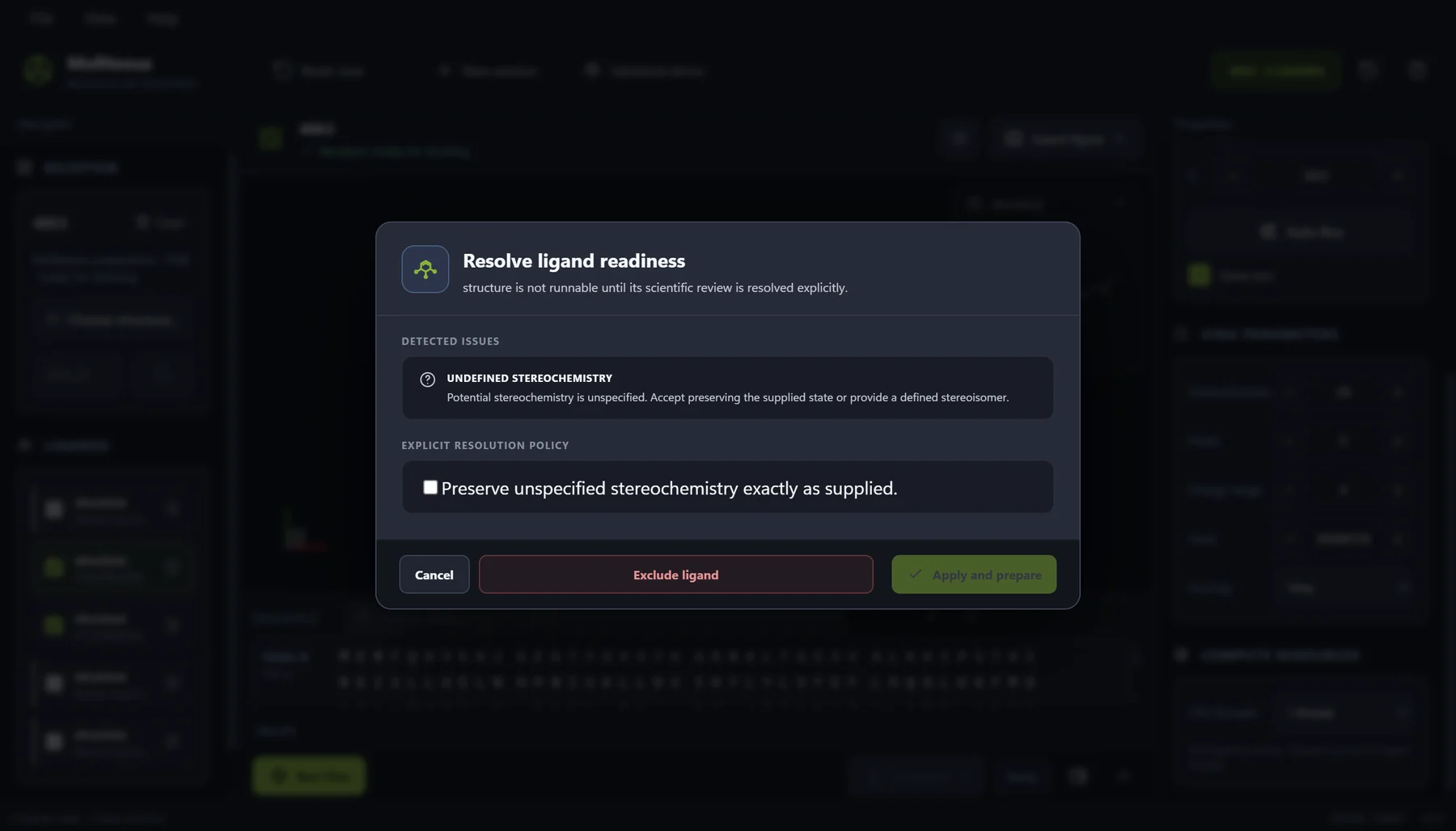
Eight source outcomes from the retained case
| Source record | Current outcome | Decision exposed before docking |
|---|---|---|
size18_1 | Review | Undefined stereochemistry remains unresolved. |
size20_1 | Rejected at import | No valid molecule record was available. |
size22_1 | Rejected at import | No valid molecule record was available. |
size24_1 | Ready; docked | Five poses retained; best displayed score −6.767 kcal/mol. |
size26_1 | Ready; docked | Five poses retained; best displayed score −6.991 kcal/mol. |
size28_1 | Review | Undefined stereochemistry remains unresolved. |
size30_1 | Rejected at import | No valid molecule record was available. |
size32_1 | Review | Undefined stereochemistry remains unresolved. |
A source-file rejection occurs before a valid ligand record enters preparation. It is not the same state as an explicit user exclusion.
The practical SDF preflight checklist
Record this before a ligand enters AutoDock Vina
| Check | Pass condition | Record when it does not pass |
|---|---|---|
| Stable source identity | Filename, record index, identifier, and checksum are retained. | Missing or ambiguous provenance. |
| Parse | Exactly the intended record yields a molecule. | Parser message and source location. |
| Connectivity and bond orders | The graph matches the authoritative source. | Conflicting atoms, bonds, or aromatic flags. |
| Formal charge and valence | Sanitization succeeds under the declared chemistry policy. | Atom-level valence or charge diagnostic. |
| Fragments | The intended component or multicomponent state is explicit. | Fragment inventory and unresolved selection. |
| Stereochemistry | Specified centers and bonds are retained; unresolved stereo follows policy. | Each undefined center or bond and the required decision. |
| Protonation, tautomer, and hydrogens | The selected state is documented and hydrogens are explicit. | Method, assumption, ambiguity, or unsupported state. |
| 3D geometry | Coordinates are finite, nonflat where appropriate, and have recorded provenance. | Generation method, geometry warning, or minimization limit. |
| PDBQT integrity | Prepared identity, expected atoms, charge, and rotatable-bond model are consistent. | Mismatch, parameterization error, and artifact hash. |
| Terminal status | Ready inputs alone enter the current docking queue. | Review or Excluded reason and any explicit resolution. |
Use this checklist before a full ligand library is launched, then keep the preparation report beside the docking record. The broader guide to preparing proteins and ligands for AutoDock Vina covers the end-to-end setup. Before scaling, the separate workflow validation guide explains how to test pose recovery, screening discrimination, and robustness.
What individual researchers and laboratories should evaluate
The same technical job in two buying contexts
| Context | Decision question | Evidence to inspect |
|---|---|---|
| Individual researcher | Can I diagnose one failing ligand without hidden transformations or a chain of disconnected tools? | Per-ligand source, preparation state, actionable diagnostic, explicit decision, and recoverable output. |
| Laboratory or organization | Can a method owner review the preparation denominator and every chemical assumption before compute or assay resources are committed? | Versioned protocol, batch-level state counts, source-to-output traceability, retained failures, and exportable records. |
Where MolNexus fits
MolNexus 0.1.1 brings ligand import and preflight, receptor preparation, interaction-box definition, AutoDock Vina 1.2.7 execution, pose review, exports, and local job history into one Windows desktop workflow. It keeps source diagnostics visible, rejects files that contain no valid molecule record, and classifies prepared records as Ready, Review, or Excluded. Only Ready inputs enter docking, and suggested resolutions are not applied automatically.
That design does not remove scientific judgment. It places the judgment at a visible gate, before a warning becomes an invisible transformation and before a batch consumes compute time.
Current MolNexus product profile
| Product | MolNexus 0.1.1, local Windows desktop molecular docking software |
|---|---|
| System | Windows 10 or Windows 11, 64-bit |
| Ligand inputs | SDF, MOL, MOL2, and PDBQT; one ligand or a batch |
| Docking engine | AutoDock Vina 1.2.7 with Vina and Vinardo scoring |
| License | US$499 one-time purchase; one Windows PC at a time; perpetual use of the purchased version; 12 months of updates |
| Availability | Available now: free two-docking trial and US$499 one-time perpetual license |
Frequently asked questions
The fastest docking run is the one that never starts with an ambiguous ligand. A preflight gate turns preparation from a hidden conversion step into a reviewable scientific record: every source remains identifiable, every warning has an owner, every exclusion stays in the denominator, and only eligible inputs consume docking time.
Use the checklist on a representative subset before scaling the library. If the same failure class repeats, improve the source or protocol once and document it, rather than patching molecules one by one without a reproducible rule.
References
- The Meeko authors. Basic ligand preparation Meeko documentation Official documentation for SDF input, explicit-hydrogen and 3D requirements, multi-record handling, and PDBQT output.
- The Meeko authors. Overview of ligand preparation Meeko documentation Official description of the RDKit-to-Meeko-to-PDBQT data flow and the parameters assigned during ligand preparation.
- RDKit contributors. Molecular Sanitization and Valence Calculation The RDKit Book Official documentation for sanitization, chemical-reasonableness checks, and allowed-valence enforcement.
- RDKit contributors. Explicit Valence Error, Partial Sanitization, and DetectChemistryProblems RDKit Cookbook Official examples for valence and kekulization diagnostics and the documented caution around partial sanitization.
- Center for Computational Structural Biology. Basic docking AutoDock Vina documentation Official tutorial recommending chemically informative small-molecule input and explicit protonation review.
- Center for Computational Structural Biology. Frequently Asked Questions AutoDock Vina documentation Official explanation of input hydrogens, donor/acceptor assignment, and the united-atom scoring boundary.
- Meeko project contributors and issue reporter. mk_prepare_ligand.py Issue #76 Meeko GitHub issue tracker (2024) Original public user report involving a large nucleic-acid aptamer, used only as a bounded qualitative example of atom-level valence and sanitization diagnostics.
- Yuel J, Lai H, Zhang J, et al.. A Diffusion-Based Framework for Designing Molecules in Flexible Protein Pockets: Dataset Zenodo (2025) DOI: 10.5281/zenodo.17702010 Original dataset record containing the YuelDesign-generated CDK2 molecules used in the documented workflow demonstration.
- RCSB Protein Data Bank. 4EK3: Crystal structure of apo CDK2 RCSB PDB (2013) DOI: 10.2210/pdb4EK3/pdb Authoritative experimental structure record for the retained apo-CDK2 receptor, including the 1.34 angstrom resolution.
- Center for Computational Structural Biology. AutoDock Vina 1.2.7 release GitHub Releases (2025) Official release record for the AutoDock Vina version integrated in MolNexus and used in the retained workflow.