How to Validate a Molecular Docking Workflow Before Screening a Ligand Library
Validate a molecular docking workflow before committing a ligand library: separate pose recovery from screening discrimination, test early enrichment and robustness, and define a defensible go/no-go decision.
A ligand library multiplies every strength and every weakness in a docking protocol. If the receptor state, chemical preparation, search space, or ranking rule is poorly chosen, running ten thousand compounds does not repair the method. It produces ten thousand consistently processed answers to the wrong question.
AutoDock Vina's own guidance recommends evaluating performance on the particular target when a bound ligand or known actives are available [1]. That target-specific qualification is the center of this guide. The objective is not to certify docking in general. It is to decide whether one documented workflow is credible enough for one intended screen.
A docking workflow has more than one validation question
| Question | Evidence | What a failure means |
|---|---|---|
| Pose recovery | Redock a crystallographic ligand and compare the predicted and experimental poses. | The protocol may not reproduce a known binding geometry under favorable conditions. |
| Screening discrimination | Rank known actives against confirmed inactives or defensible decoys. | The score may not prioritize useful candidates for this target and library context. |
| Early recognition | Measure how many actives appear in the small fraction that could realistically be reviewed or tested. | A reasonable overall ranking may still place too few actives near the top. |
| Repeatability and sensitivity | Repeat controlled runs and perturb justified settings one at a time. | The conclusion may depend on one seed, one narrow setup, or one preparation choice. |
Validation is a claim with a boundary
A successful redocking result supports a pose-recovery claim for the tested complex and protocol. It does not automatically support a library-ranking claim. A favorable enrichment result supports a ranking claim for the tested target, controls, and metric. It does not prove that every top-ranked compound binds experimentally.
This separation is not semantic caution. A 2025 benchmark found that docking accuracy, structural rationality, and virtual-screening enrichment can produce different method rankings [7]. A workflow can therefore be good at reproducing a reference pose yet weak at finding actives early—or rank actives while generating poses that still need physical inspection.
Match the claim to the test
| Claim you want to make | Minimum relevant test | Claim you still cannot make |
|---|---|---|
| The protocol can reproduce this known pose. | Cognate-ligand redocking with an explicit pose-comparison method. | The protocol will rank unseen actives correctly. |
| The protocol separates controls for this target. | Target-relevant active/inactive or active/decoy ranking. | The score is an experimental binding constant. |
| The top of the ranked list is useful. | An early-recognition metric at a prespecified review budget. | Every highly ranked molecule is a hit. |
| The workflow is operationally reproducible. | Versioned inputs, fixed settings, retained seeds, outputs, and reruns. | The biological hypothesis is correct. |
1. Define the intended screen and freeze the protocol
Start with the decision the screen must support. Is the goal to prioritize 20 compounds for manual review, select 100 for an experimental assay, or compare chemotypes within a focused series? The review budget determines which part of a ranked list matters and therefore which validation metric deserves priority.
Freeze the scientific workflow before the decisive validation set is scored. That includes receptor structure and chain, retained cofactors or waters, protonation assumptions, ligand state generation, binding-site definition, box coordinates, scoring function, exhaustiveness, seeds, pose count, and the rule used to convert poses into one compound ranking. Use the separate guides for protein and ligand preparation and Vina search-space design when those components are not yet fixed.
The protocol record to freeze before validation
| Layer | Record |
|---|---|
| Target model | Structure identifier, chain, receptor state, retained components, preparation method, and final file hash. |
| Ligand preparation | Source structures, stereochemistry policy, protonation and tautomer rules, conformer method, and final file hashes. |
| Search hypothesis | Binding-site provenance, box center and size, flexible residues if any, and the reason for each choice. |
| Engine configuration | Engine and version, scoring function, exhaustiveness, seed policy, pose count, energy range, and other nondefault settings. |
| Ranking rule | Which pose or aggregate score represents each compound, how ties are handled, and what fraction will be reviewed. |
| Acceptance criteria | Prespecified pose-recovery, early-recognition, repeatability, and physical-review requirements. |
2. Validate the inputs and binding-site hypothesis first
Outcome metrics cannot rescue chemically inconsistent inputs. Inspect the receptor for unresolved or alternate atoms, missing site residues, unexpected chains, relevant metals, cofactors, and water-mediated interactions. Confirm ligand stereochemistry, valence, protonation, tautomer selection, and rotatable-bond treatment before comparing scores.
The site must also match the intended mechanism. A co-crystallized ligand can anchor a focused box, but the receptor conformation may favor that ligand class. If the prospective library targets a different state, pocket, or chemotype, include the resulting structural uncertainty in the validation design rather than hiding it inside one coordinate file.
3. Use redocking to test pose recovery
For cognate redocking, remove the crystallographic ligand, prepare it through the intended ligand workflow, and dock it back into the prepared receptor without using its final coordinates as a restraint. Compare the predicted pose with the experimental pose after a clearly described receptor alignment and atom-mapping procedure.
Heavy-atom RMSD is common, but atom correspondence matters. Symmetric ligands can receive artificially inflated RMSD values when naïve atom ordering is used. DockRMSD demonstrated why symmetry-aware graph mapping can change that interpretation [3]. A 2 Å threshold is widely used as a practical pose-recovery convention, not as a universal physical law.
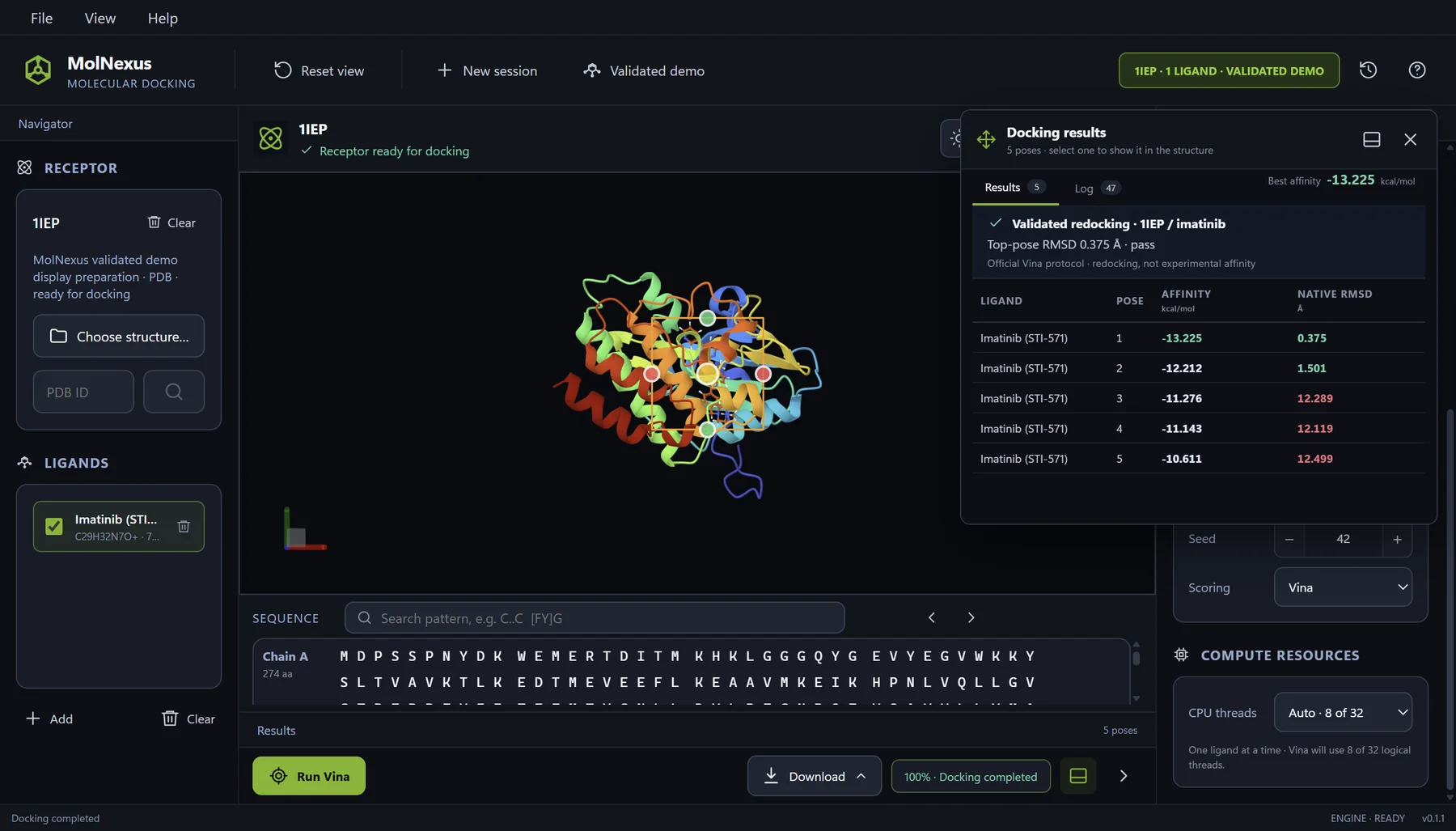
The current case uses the experimental c-Abl structure 1IEP [8], AutoDock Vina 1.2.7 [9], a fixed seed of 42, exhaustiveness 32, and a 20 Å cubic search space. The top pose reproduced the crystallographic ligand at 0.375 Å under the preset's native-ligand comparison and passed its 2.0 Å threshold.
That result is useful and deliberately narrow. It shows that this configuration can recover one known pose. It does not show whether imatinib analogues, confirmed inactives, or an unrelated library will be ranked effectively. Those require a different challenge.
4. Challenge the ranking with target-relevant controls
Build a control panel that resembles the decision the future screen must make. Include chemically diverse confirmed actives when available, not only close analogues of one co-crystallized ligand. Use experimentally confirmed inactives when the assay context is compatible. When those are unavailable, carefully constructed property-matched decoys can test whether a 3D method adds ranking value beyond simple molecular properties.
DUD-E was designed with property-matched decoys and improved chemotype diversity, but its authors also documented limitations, including possible artificial enrichment [4]. LIT-PCBA instead derived target sets from dose-response PubChem bioassays and retained confirmed actives and inactives while reducing obvious and hidden biases [5]. Neither resource is automatically the right benchmark for a private target; their design principles explain what a credible control set must confront.
Choose controls for the question, not for an easy result
| Control type | What it can test | Important boundary |
|---|---|---|
| Co-crystallized ligand | Pose recovery and site setup. | One ligand in its cognate receptor does not measure screening discrimination. |
| Known actives | Whether relevant chemistry can appear near the top. | A narrow analogue series may reward ligand similarity rather than general screening ability. |
| Confirmed inactives | Discrimination within a compatible experimental assay context. | Assay conditions, target construct, and activity labels must match the intended claim. |
| Property-matched decoys | Whether ranking exceeds simple size, charge, or other property differences. | A decoy is designed to be unlikely to bind; it is not necessarily an experimentally confirmed inactive. |
| Alternative receptor states | Sensitivity to conformation and pocket definition. | Combining structures can improve coverage or introduce incompatible hypotheses. |
5. Use metrics that match the review budget
A compact molecular docking validation scorecard
| Metric or review | Question answered | Why it is not enough alone |
|---|---|---|
| Symmetry-aware pose RMSD | How closely does a redocked pose reproduce the experimental pose? | It evaluates pose recovery, not compound ranking. |
| ROC-AUC | How well are actives ranked above controls across the full list? | A screen may care mainly about the first small fraction. |
| EF at a prespecified fraction | How concentrated are actives near the review cutoff relative to random selection? | It depends on the chosen fraction, active prevalence, and control-set construction. |
| BEDROC | Does the ranking recognize actives early with an explicit weighting? | The weighting parameter must reflect the intended screening decision [6]. |
| Pose plausibility review | Do top poses avoid obvious clashes and preserve credible pocket interactions? | Visual plausibility is not experimental activity. |
| Seed and perturbation stability | Does the conclusion survive controlled reruns and reasonable setup changes? | Stable output can still be systematically wrong. |
ROC-AUC summarizes the full ranking, while early-enrichment measures emphasize the compounds that will actually be reviewed. Truchon and Bayly introduced BEDROC to formalize early recognition and showed that metric parameters and sample composition affect interpretation [6]. Report the metric definition, cutoff, active prevalence, confidence or resampling procedure, and the full control-set composition rather than publishing one unexplained number.
Do not choose the cutoff after seeing which value looks best. If the laboratory can inspect or purchase the top 1%, validate performance at that budget. If only 25 compounds can advance, evaluate that operational cutoff as well.
6. Test repeatability and sensitivity
Perturb one assumption at a time
| Controlled variation | What to compare | Warning sign |
|---|---|---|
| Random seed | Pose-family recurrence, rank stability, and early enrichment. | One favorable seed carries the conclusion. |
| Exhaustiveness | Whether more search effort changes poses or control ranking materially. | The selected setting has not reached a stable operational region. |
| Small justified box changes | Site occupancy and ranking near the intended pocket. | Minor boundary movement completely reorganizes the result. |
| Plausible protonation or tautomer states | Pose and rank sensitivity for affected controls. | The conclusion depends on one undocumented chemical state. |
| Relevant receptor conformations | Whether the same chemotypes remain credible across supported states. | The screen is dominated by one receptor conformation without justification. |
7. Make the go, revise, or stop decision before the library run
Turn validation into an operational decision
| Decision | Evidence pattern | Next action |
|---|---|---|
| Proceed | Pose recovery is interpretable, controls show useful prespecified early recognition, top poses remain plausible, and conclusions are stable enough for the review budget. | Freeze the protocol, screen the library, and preserve the complete run record. |
| Revise once | A specific, scientifically defensible failure is isolated—for example, a wrong receptor state or inadequate search space. | Change that component, document why, and repeat the full validation rather than keeping only improved metrics. |
| Stop or change method | The workflow repeatedly fails pose recovery, cannot enrich relevant controls, produces implausible poses, or remains unstable under reasonable settings. | Avoid spending the full library budget; reconsider the receptor model, scoring approach, or screening strategy. |
A compact pre-screening validation plan
Seven artifacts to retain
| Step | Required artifact |
|---|---|
| 1. State the decision | Target, library scope, review or assay budget, and intended claim. |
| 2. Freeze inputs | Versioned receptor and ligand files plus preparation provenance. |
| 3. Freeze configuration | Site, box, engine version, scoring function, seeds, exhaustiveness, pose settings, and ranking rule. |
| 4. Recover a known pose | Experimental reference, alignment method, atom mapping, RMSD, and pose inspection. |
| 5. Test screening controls | Active/inactive or active/decoy provenance, property audit, ranks, and prespecified metrics. |
| 6. Test robustness | Seed repeats and one-variable sensitivity comparisons. |
| 7. Record the decision | Proceed, revise, or stop; rationale; accepted boundaries; and final frozen protocol identifier. |
What MolNexus supports in this validation workflow
MolNexus 0.1.1 brings receptor and ligand preparation, interaction-box setup, AutoDock Vina 1.2.7 execution, scoring selection, pose review, exports, and local docking-job history into one Windows desktop workflow. The interface exposes core controls such as center, size, exhaustiveness, seed, pose count, and energy range, making the protocol easier to inspect and recover.
Current ligand handling distinguishes source files rejected before preparation from valid records that become Ready, Review, or explicitly Excluded. Only Ready inputs enter docking, and suggested resolutions are not applied automatically, so a warning cannot silently become a new chemical assumption.
For validation, that operational continuity matters: the same frozen configuration can be applied to a compact control set before the larger batch supported by Vina's sequential docking workflow [2]. Results and configurations can be retained for external analysis instead of being reconstructed from disconnected commands and folders.
The same workflow decision in two buying contexts
| Buyer context | Practical question | Evidence to inspect |
|---|---|---|
| Individual researcher | Can I run controls, inspect poses, repeat settings, and recover the exact protocol without rebuilding the workflow each time? | Authentic receptor, box, parameter, result, export, and local-history views. |
| Laboratory or organization | Can a method owner review the inputs, controls, settings, outputs, and decision boundary before compute or assay resources are committed? | Version visibility, retained job records, exportable results, reproducible reruns, and explicit deployment scope. |
Frequently asked questions
The most economical time to discover that a docking workflow is weak is before the full library enters it. A compact validation panel can expose a wrong receptor state, biased controls, unstable sampling, or ineffective early ranking while the protocol is still inexpensive to revise.
Once the workflow passes its prespecified decision, freeze it, preserve the control evidence, and apply it consistently. After the screen, use the separate guide to interpret Vina affinity, RMSD bounds, and pose families, and compare Vina and Vinardo only when scoring-function choice is itself part of a documented validation question.
References
- Center for Computational Structural Biology. Frequently Asked Questions AutoDock Vina documentation Official guidance on target-specific evaluation, decoy selection, stochastic search, seeds, exhaustiveness, and scoring limitations.
- Center for Computational Structural Biology. Docking in batch mode AutoDock Vina documentation Official documentation for sequentially docking a ligand set against a receptor in a virtual-screening workflow.
- Bell EW, Zhang Y. DockRMSD: an open-source tool for atom mapping and RMSD calculation of symmetric molecules through graph isomorphism Journal of Cheminformatics (2019) DOI: 10.1186/s13321-019-0362-7 Original peer-reviewed method and evaluation for symmetry-aware ligand pose RMSD calculation.
- Mysinger MM, Carchia M, Irwin JJ, Shoichet BK. Directory of Useful Decoys, Enhanced (DUD-E): Better Ligands and Decoys for Better Benchmarking Journal of Medicinal Chemistry (2012) DOI: 10.1021/jm300687e Original DUD-E benchmark paper describing property-matched decoys, increased chemotype diversity, and benchmark caveats.
- Tran-Nguyen VK, Jacquemard C, Rognan D. LIT-PCBA: An Unbiased Data Set for Machine Learning and Virtual Screening Journal of Chemical Information and Modeling (2020) DOI: 10.1021/acs.jcim.0c00155 Original benchmark paper using dose-response PubChem bioassays, confirmed actives and inactives, and bias-reduction procedures.
- Truchon JF, Bayly CI. Evaluating Virtual Screening Methods: Good and Bad Metrics for the “Early Recognition” Problem Journal of Chemical Information and Modeling (2007) DOI: 10.1021/ci600426e Original BEDROC paper formalizing early-recognition evaluation and its statistical and parameter considerations.
- Gu S, Shen C, Zhang X, Sun H, Cai H, Luo H, Zhao H, et al.. Benchmarking AI-powered docking methods from the perspective of virtual screening Nature Machine Intelligence (2025) DOI: 10.1038/s42256-025-00993-0 Original benchmark separating redocking accuracy, structural rationality, and virtual-screening enrichment performance.
- RCSB Protein Data Bank. 1IEP: Crystal structure of the c-Abl kinase domain in complex with STI-571 RCSB PDB (2001) Authoritative experimental structure record for the retained c-Abl-imatinib redocking case.
- Center for Computational Structural Biology. AutoDock Vina 1.2.7 release GitHub Releases (2025) Official release record for the AutoDock Vina version integrated in MolNexus and used in the retained case.